
Health Impacts
Aerosol particles can have many detrimental impacts on human health and wellbeing as well as being used to deliver drugs to the lungs for the treatment of disease. CDT projects are examining nanoparticles from non-exhaust emissions, their lung deposition and potential health impacts, the health impacts of indoor aerosol, the mechanisms of interaction of pollution particles with airway epithelial cells, and how atmospheric particulate affects lung infection and immune response.
Harmful pyrolytic by products from smoking and vaping drugs of abuse
Many drugs of abuse, such as heroin and cocaine are smoked. This produces by-products that cause additional harm alongside the intrinsic risks of the drugs. The by-products produced by most drugs and their toxicity are unknown. Vaping might be safer, as the lower operating temperature may produce fewer by-products.
This project will use a smoking simulator to characterise the by-products from smoking and vaping. Their site of deposition in the lungs will be estimated by measuring their particle size. The toxicity of individual by-products and the mixtures produced by smoking will be investigated using lung organoids and cell toxicity assays.
PhD student: Alana Hann
Cohort: 7
Lead supervisor: Prof. Matthew Jones
Institution: University of Bath
Characterisation and mitigation of particle emissions from 3D printing processes
The widespread adoption of 3D printing is rapidly increasing the use of desktop printers in businesses, public spaces and homes. However, users may be unaware of how to use this technology safely in terms of indoor air quality. This PhD project will develop emissions sampling and characterisation methodologies, understand emissions formation and transformation processes in real-world 3D printing emissions environments and create solutions to mitigate 3D printing emissions. The project will assist those developing/using 3D printers to develop safe- and sustainable-by-design products with low environmental impact. Findings will be disseminated via publications/conferences, CDT website, social media, public engagement activities.
PhD student: Emily Culshaw
Cohort: 7
Lead supervisor: Dr Jose Herreros
Institution: University of Birmingham
Aerosolised Nanoparticles and Mechanisms of Lung Fibrosis
With aerosolised nanomaterials becoming more prevalent from diverse sources, it’s increasingly crucial to comprehend their implications on human health. The focus of this research project lies on lung fibrosis, a severe lung condition often triggered by inhaled nanomaterials, causing lung tissue damage and chronic inflammation. We seek to understand the underlying mechanisms behind fibrosis, thereby enhancing toxicological assessments and facilitating early detection and treatments. This study seeks to redefine our understanding of nanomaterial-induced lung fibrosis, employing diverse methodologies encompassing material characterisation, toxicology, and molecular biology to comprehensively study fibrosis onset and progression post-exposure to nanomaterials.
PhD student: Nigel Taruwinga
Cohort: 7
Lead supervisor: Dr Laura Urbano
Institution: University of Hertfordshire
Exploring the Size-Resolved Toxicological Properties of Aerosols
Air pollution has been declared a public health emergency by the World Health Organisation, yet significant gaps remain in understanding the most harmful characteristics of the different pollutants. This project aims to investigate the impact of aerosol particle size and shape on health, focusing on their toxic and inflammatory effects on human lung cells. Candidates will collaborate with leading experts in aerosol science, toxicology, and immunology to develop innovative solutions with substantial industry applications. By utilizing state-of-the-science facilities and technology, this research provides a unique multidisciplinary approach to addressing air pollution, contributing to essential public health advancements and product development.
PhD student: Zahria Pinera-Monterrey
Cohort: 7
Lead supervisor: Dr Aristeidis Voliotis
Institution: The University of Manchester
This project is an industry funded studentship supported by Cambustion

Developing model systems to understand the impacts of pollutants on lung health
Air pollution is the biggest environmental threat to health in the UK causing premature deaths and driving the development and worsening of respiratory disease and lung cancer and worsens the outcomes of respiratory infections such as influenza and COVID-19. Despite the significance of air pollution for health, little is understood about the underlying immunological mechanisms. Models that have appropriate aerosol deposition methods alongside appropriate cell culture systems are needed to understand the dynamic interactions between diverse particulates and lung cells. This project will combine multidisciplinary expertise to assess and optimise in vitro models to understand how pollution impacts the lungs.
PhD student: Amy Forsbacka
Cohort: 6
Lead supervisor: Prof. Sheena Cruickshank, Prof. Gordon McFiggans, Dr. Cyrill Bussy, Prof. Tracy Hussell, Dr. Aristeidis Voliotis, Prof. Victoria Hutter
Institution: University of Manchester
This project is sponsored in partnership with ImmuONE

Exposure on a chip to better design aerosolised drug delivery deep into the lungs
By 2030, organ-on-a chip technologies will play a key role in mechanistic biomedicine and pharmacology research and in the clinic, in diagnostic and treatment workflows, informing the right personalised drug dose. We propose to develop a microfluidic alveolus-on-a-chip (AOC) whereby multiple exposure regimes by means of pressure and flows can be modelled and integrate it on a microscope coupled with a high-resolution/high-speed camera to resolve quantitatively molecular spatiotemporal events by means of image correlation spectroscopy.
By the end of this project, we will have built a highly versatile AOC imaging platform that will fill the current gap in in-vitro airways exposure methods and techniques This project will bring bioengineering approaches to impact the crossdisciplinarity fields of biophysics, biochemistry and 4D molecular respiratory physiology.
PhD student: Felix Dobree
Cohort: 5
Lead supervisor: Dr Jorge Bernardino de la Serna
Institution: Imperial College London

Chemical and toxicological properties of aerosol emissions subject to atmospheric processing
As our understanding of atmospheric aerosols improves, we need to account for emissions not just in terms of primary particulates, but also ‘condensable’ material that is capable of forming secondary aerosols in the atmosphere. For the purposes of accounting for long range pollution and studying the effects on human health, this project will work with Dekati to develop their Oxidation Flow Reactor (OFR) for standardised simulations of atmospheric processing of aerosols such that condensable particulates can be measured at the point of emission. The chemical and health-affecting properties of the aerosols produced will also be studied in detail.
PhD student: Joseph Bainbridge
Cohort: 5
Lead supervisors: Dr James Allan & Prof Gordon McFiggans
Institution: The University of Manchester
This project is an industry funded studentship supported by DEKATI


Understanding how pollutant aerosol particulates impact airway inflammation
Exposure to particulate matter (PM) contributes to respiratory diseases with major impacts from early life exposure yet we know little of the underlying immunological mechanisms. Increasing evidence implicates a process of “innate imprinting” whereby prior inflammation alters subsequent responses increasing inflammation. This is particularly problematic for infant development and subsequent responses to infection and allergy. This project will develop a range of particulates in order explore the cellular response to PM aerosols and innate imprinting in airway inflammation.
PhD student: Armin Markazi Omidvar
Cohort: 5
Lead supervisor: Prof Sheena Cruikshank
Institution: The University of Manchester
This project is an industry funded studentship supported by UKHSA


Air pollution from tyres
With the ongoing transitions to hybrid and electric vehicles, tailpipe emissions will continue to fall but non-exhaust emissions are expected to rise. While a large body of research has been already done on the quantification of tailpipe emissions, their atmospheric fate, and their impact on public health, such information for non-exhaust emissions is currently scarce.
The aim of this PhD project is to fill the gap of knowledge on non-exhaust emissions, through an in-depth size and chemical characterisation and by assessing their intrinsic ability to cause lung inflammation and exacerbate diseases.
PhD student: Siriel Saladin
Cohort: 4
Lead supervisors: Dr Chiara Giorio
Institution: University of Cambridge
Workplace lifecycle exposure and health risk for advanced materials
Advanced materials are expected to play a prominent part in the future of many industries. Some may pose potential risks to health from inhalation of hazardous particulate substances produced during manufacturing, processing and use. This project aims to support the safe innovation and commercialisation of advanced materials by evaluating the potential for occupational exposure across the material lifecycle.
PhD student: Samantha Hall
Cohort: 4
Lead supervisors: Prof. Martie Van Tongeren, Dr Cyrill Bussy, Dr Delphine Bard
Institution: The University of Manchester

Dispersion behaviour and health effects of indoor aerosols
Indoor aerosols may contribute to negative health effects. This project will measure the physical and chemical nature of indoor aerosol pollutants produced within the home. Placements to conduct an epidemiological literature review and investigate the health effects of these aerosol will enable a risk analysis of the measured aerosol.
PhD student: Prem Kumar Perumal
Cohort: 3
Lead supervisor: Prof Dudley Shallcross and Dr James Matthews
Institution: University of Bristol
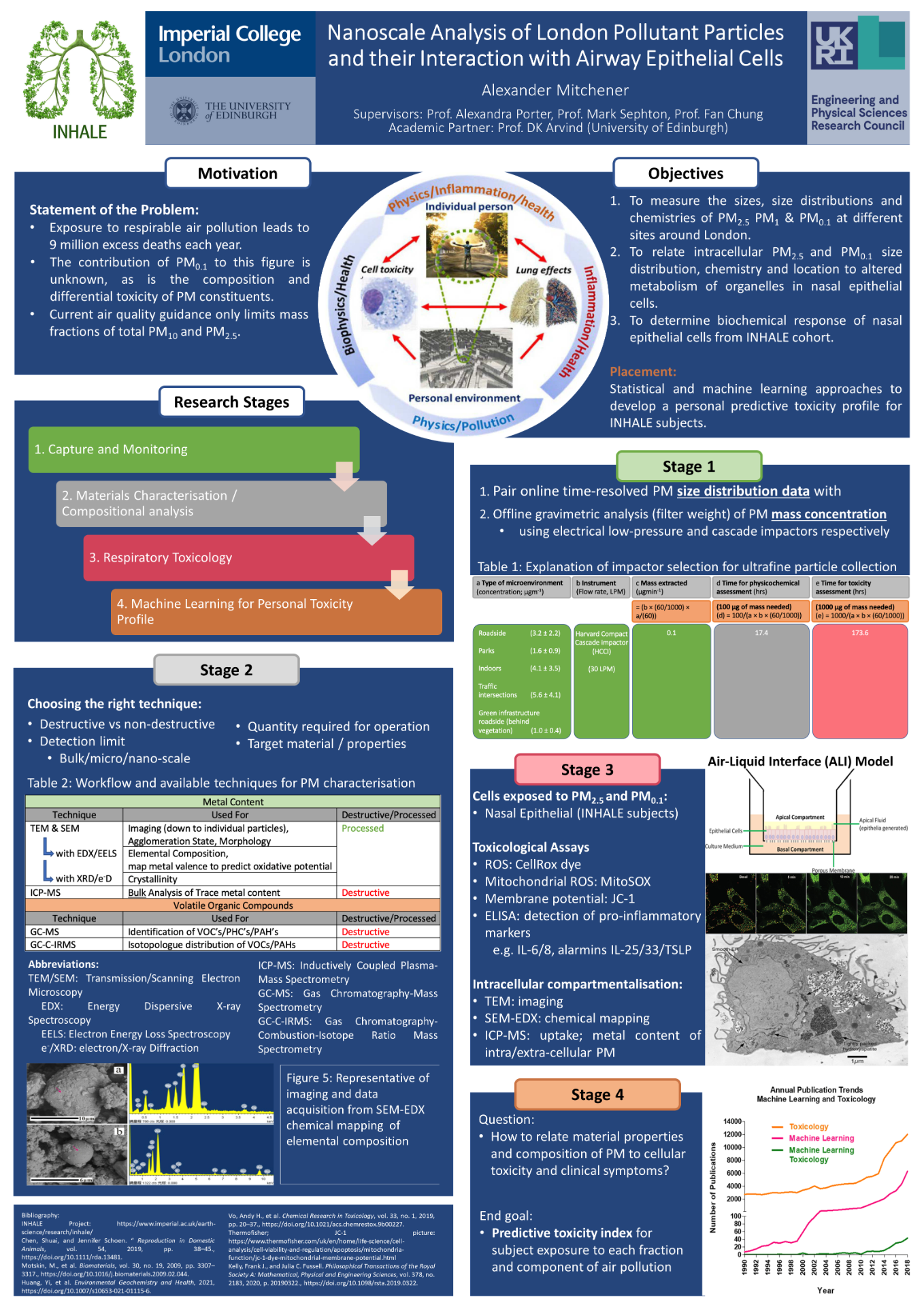
Nanoscale analysis of London pollutant particles and their interaction with airway epithelial cells
This PhD project will compare the health impacts of micro and nanosized air pollution particles in outdoor and indoor environments in London. The student will establish which properties and components of different pollutants determine their cellular fate, their potential for cell & tissue damage and how these impact health outcomes.
PhD student: Alexander Mitchener
Cohort: 3
Lead supervisor: Prof Alexandra Porter
Institution: Imperial College London
Air pollution and cardiac health
Air pollution enhances the risk of cardiovascular disease through direct and indirect effects on the heart. Through epidemiological investigation, and in collaboration with industry, this studentship will determine the role of altered immune function and oxidative stress in contributing to pollution-associated cardiac dysfunction using in vitro and in vivo models.
PhD student: Joe Morris
Cohort: 3
Lead supervisor: Dr Holly Shiels
Institution: The University of Manchester
How atmospheric particulate affects lung infection and immune response
Air pollution poses a serious threat to human health and is an aggravating factor in both viral and bacterial pulmonary infections. This project will employ advanced in vitro and computational models to develop an understanding of the complex and still vastly unexplored interaction between bacteria, pollutants and immune cells.
PhD student: Samuel Hyman
Cohort: 3
Lead supervisors: Prof. David Topping
Institution: The University of Manchester
In vitro modelling of lung response to environmental nanoparticulates
Environmental nanoparticulates can gravely impact health, leading to cardiopulmonary diseases and lung cancer. This project will bring together cutting-edge in vitro lung models, advanced deposition technologies and image analysis algorithms to characterise the lung tissue response to environmental nanoparticulate and to shed light upon their mechanisms of toxicity.
PhD student: Altin Kocinaj
Cohort: 2
Lead supervisors: Dr Laura Urbano and Prof Darragh Murnane
Institution: University of Hertfordshire
Evaluation of the health impacts of aircraft nanoparticles using a surrogate soot source and in vitro cell exposure
Aircraft engines emit nanoparticles that may have specific health consequences due to their size and composition, especially near airports. This project will develop a laboratory source of surrogate aircraft soot particles that will be deposited on cell cultures to evaluate cellular responses and advance understanding of nanoparticle health impact pathways.
PhD student: Georgia Gamble
Cohort: 2
Lead supervisor: Dr Marc Stettler
Institution: Imperial College London
Determining the effects of airborne particulates on immune and barrier epithelial cell function
Airborne pollution is a complex mixture of biological and chemical sources but their specific effects on immune function are relatively poorly understood. This exciting cross disciplinary project will define the components of pollutants and explore their impact on immune cells.
PhD student: George Adams
Cohort: 1
Supervisors: Prof. Sheena Cruickshank (Manchester) and Dr. Alberto Gambaruto (Bristol)
Institution: The University of Manchester

EPSRC CDT in Aerosol Science
University of Bristol
School of Chemistry
Cantock’s Close
Bristol, BS8 1TS
aerosol-science@bristol.ac.uk
Connect with us




Partner Newsletter
Sign up to receive monthly news and updates from the CDT in Aerosol Science, as well as events, training and research webinars.